Teleoperation services, from remote driving to step-in help
Pick how much the robot does alone. That decides how many people you need, the network and how you are billed.
Remote driving
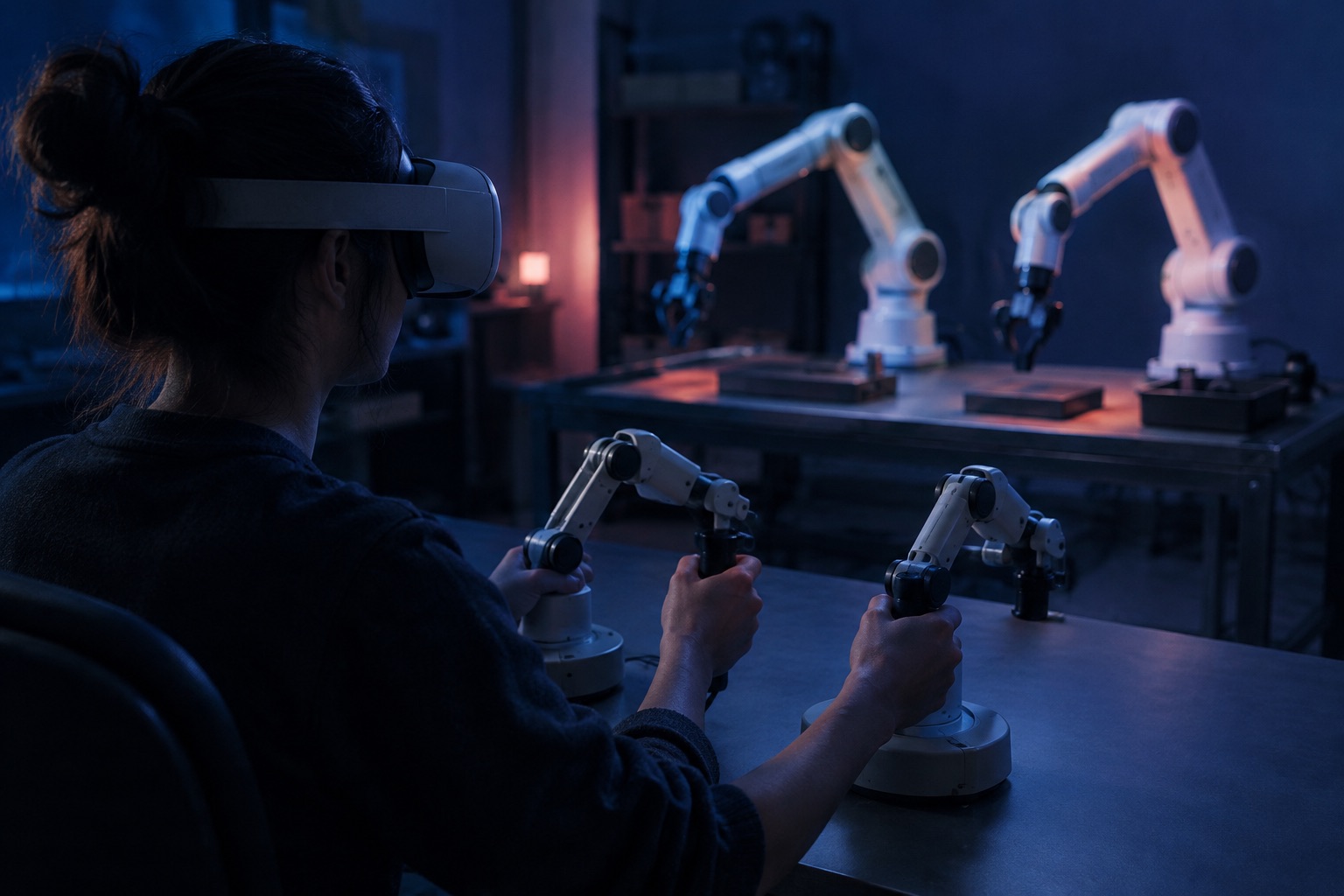
An operator steers the robot through the whole task from a station, usually with leader arms or a VR headset.
- Good for
- Recording demonstrations to train a robot, and tasks it cannot do alone yet
- Network it needs
- Under 50 ms round trip for contact work, 100 to 200 ms for pick and place
- Usually billed
- Per hour, per accepted hour of data, or per package of demonstrations
One operator per robot, 4 to 6 hours of driving a day each
What each service costs, where a price is published
Only data recording has public prices. Fallback and monitoring are quoted per fleet.
| Service | Billed by | Published price |
|---|---|---|
| Remote driving to record data | Accepted hour of data | from $12 per accepted hour, 500 hours minimum1 |
| Remote driving to record data | Operator hour | $28–$60 per hour, by rig and task2 |
| Remote driving to record data | Demonstration package | $2,500 for 20 demos, $8,000 for 1003 |
| Remote driving of cars, billed to riders | Minute | $0.30 per minute driving, at launch in 20244 |
| Step-in help for a deployed fleet | Robot or hour of cover | – |
| 24/7 fleet monitoring | Robot per month or site | – |
A dash means no public price; vendors quote per fleet.
What a service should include
- Operators and a shift lead. Named cover for every hour you buy, with breaks planned in.
- Stations. Who provides the rigs, headsets and spare parts, and who fixes them.
- Network checks. Delay and bandwidth tested before each session, with a stop rule.
- Quality review. Who checks the recorded episodes and what counts as accepted.
- A log. Every takeover or failed attempt written down with its cause.
- Data terms. Ownership, storage location and deletion, in the contract.
Questions buyers ask
Which service do I need first?
If you are still training the robot, remote driving to record demonstrations. If robots are already deployed, step-in help, because every stuck robot is downtime until someone answers.
Can one vendor do all four?
Some can. Firms that record training data tend to offer remote driving and data review. Fleet makers often run their own command centres for their own robots. Ask which of the four a vendor staffs today.
Who owns the data the operators record?
Whatever the contract says. Put ownership, licence and deletion in writing before the first session, including the camera footage, not only the robot actions.
Do operators need to be near the robots?
No, but distance adds delay. Wired fibre stays under about 30 ms round trip in one country and under 80 ms between continents, which suits most work except precise contact tasks.
Not sure which of the four you need?
Tell us your robots and hours. We read the brief and come back with what fits.
Sources (6)
- Physical Data, pricing on home page · 2026-11-16
- DexSet, egocentric data collection for robotics · 2026-11-16
- Robotics Center (SVRC), custom collection · 2026-11-17
- Vay, launch of remotely driven cars in Las Vegas · 2024-01-17
- Robotics Center (SVRC), teleoperation and internet delay · 2026-04-07
- Vecna Robotics, Pivotal Command Center · 2026-11-17